

India a Hell-hole – Dr. Donald Trump: Phd!
Post On:April 25, 2026
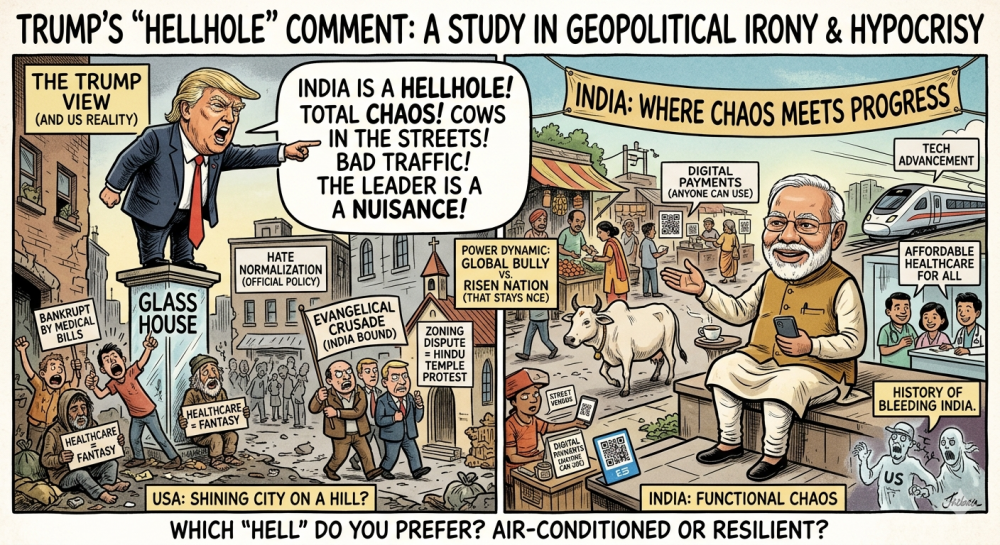
The “Hellhole” vs. The Glass House: A Study in Geopolitical Irony
Well, he’s finally said it. In a display of his trademark diplomatic “finesse,” Donald Trump has labeled India a “hellhole.” It’s the kind of nuanced geopolitical analysis we’ve come to expect—delivered with the confidence of a man who thinks Taco Bell is a cultural exchange program. But as we peel back the layers of this “shining city on a hill” rhetoric, we find a study in staggering hypocrisy and the classic mechanics of a global bully.
The Chaos vs. The “Civilized” Rot
To be fair, if your definition of a “hellhole” is a place where you can’t get a latte without navigating a six-lane highway shared with cows and wedding processions, Trump has a point. India is a logistical nightmare—a frantic, honking beast where “one-way” signs are merely polite suggestions.
But let’s look at the “heavenly” American alternative. In India, you might get stuck behind a bullock cart, but you won’t go bankrupt because you tripped on a sidewalk. While the U.S. banking system still clings to paper checks like it’s 1954, a vegetable vendor in a rural Indian village is accepting instant mobile payments via QR code. India is a digital powerhouse masquerading as chaos; the U.S. is often a bureaucratic relic masquerading as the future.
The One-Way Street of “Freedom”
The irony deepens when we look at cultural “exchange.” India provides unfettered access to U.S. evangelical groups who treat the subcontinent like a spiritual frontier for their crusades. Yet, back in the “civilized” USA, Hindu temples are routinely targeted, vandalized, and ridiculed. It is a fascinating double standard: the “hellhole” opens its doors to those seeking to dismantle its culture, while the “paradise” struggles to let a local temple exist without a “zoning dispute” that sounds suspiciously like a protest.
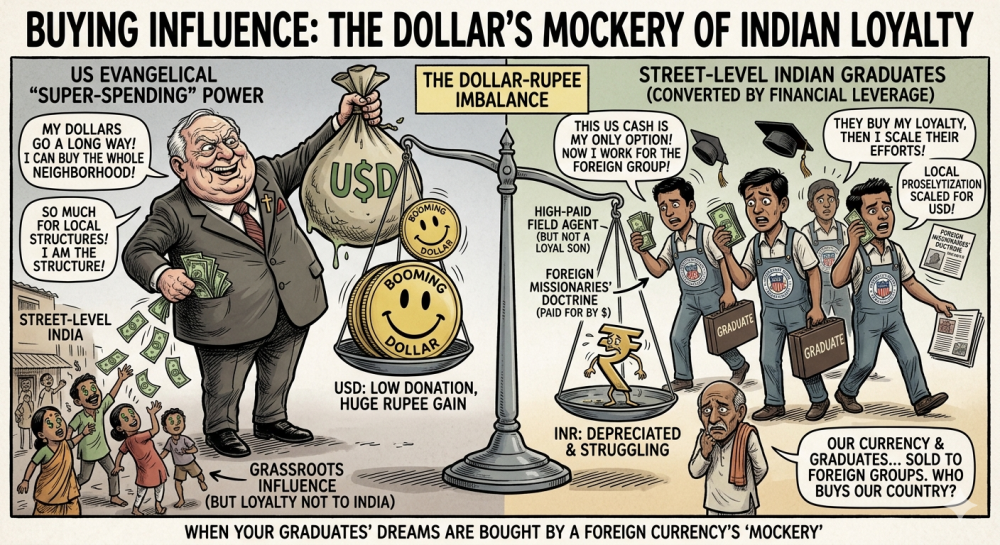
The dollar-rupee Imbalance:
The dollar-rupee imbalance grants U.S. evangelical groups “super-spending” power, turning modest foreign donations into massive local war chests. This financial leverage is used to hire unemployed Indian graduates as high-paid “field agents,” effectively buying their loyalty to scale proselytization efforts. By funding these local networks, foreign organizations purchase deep, street-level influence that out competes local social and economic structures.
Official Hate and Mercenary Management
The rhetoric isn’t just coming from the top. We have U.S. officials—the self-appointed guardians of liberty—actually calling for the normalization of hate against Indians. Remarkably, no Indian official has reciprocated. Apparently, Indian politicians haven’t yet mastered the Western art of officially sanctioning bigotry against an entire nationality.
Furthermore, while U.S. “consultants” and mercenaries have a storied history of training sections of the Indian population to “rebel” in the name of various interests, the U.S. remains curiously free of Indian mercenaries training rebels in the Appalachians. One side respects national sovereignty; the other treats the globe like a high-stakes game of Risk.
A History of Bleeding
History provides the ultimate reality check. When the USA spent the last few decades at war with half the world, India did not spend its time funneling weapons to America’s adversaries to “bleed” them dry. Contrast that with the American track record: every time India faced its enemies, the U.S. was frequently there, providing hardware and diplomatic cover to the other side.
The Bully’s Calculus
Ultimately, Trump’s remark is typical of any bully: you pick the “nice person”—the one who plays by the rules, avoids retaliation, and maintains dignity—to establish your emotional dominance. It is easier to kick a partner who won’t kick back than to address the actual rot in your own backyard.
Is India a “hellhole”? Only if you hate color, resilience, and the terrifying realization that a developing nation is out-pacing you in tech and restraint. We could write multiple PhD’s on this subject, but Trump’s single, frustrated remark proves the point more efficiently than any thesis ever could. It’s a lot of noise coming from a glass house that is currently being pelted with its own stones.
Moving Beyond Trump!
The U.S. does, however, maintain certain individual safeguards that are currently absent in India
The Experience of Corruption:
-
In the USA: You will almost never be asked for a bribe by a policeman, a doctor, or a DMV clerk. Corruption happens “at the top” in boardrooms and Washington D.C., through super PACs and special interest groups.
-
In India: While the “top-level” scams have decreased in recent years due to digitization, the average citizen still encounters “retail corruption”—paying a “speed fee” to get a passport processed faster or a bribe to avoid a traffic ticket.
-
In the USA, rights act as a rigid shield for the individual, prioritizing personal autonomy and freedom from state interference above all else. This is backed by a predictable legal system where the “rules of the game” are consistently applied and street-level corruption is practically non-existent.
-
In India, individual rights are a flexible fabric, often balanced against community harmony and social stability through “reasonable restrictions.” Respect for the law is frequently challenged by massive judicial delays and petty bureaucracy, forcing citizens to navigate a system defined more by social negotiation than strict procedural certainty.
( Article by Gopala Krishna with the help of Gemini Ai)